
Contenido

So, you’ve produced some contenido de calidad, your website looks beautiful, and you’ve got products that people want. However, you still have to scroll through page after page of Google search results before you can find your site. Therefore, you might be wondering: what’s going wrong?
Hay muchas formas de mejorar su rendimiento en Google. Uno de los métodos más eficaces es añadir enlaces contextuales. Estos enlaces pueden tener un impacto positivo en su posicionamiento en buscadores.
In this post, we’ll take a closer look at contextual links and how they can improve your rankings. We’ll also look at some best practices for using them on your site. Let’s get started!
Introducción a los enlaces contextuales (y por qué son importantes)
A contextual link is typically placed within the body of a post or page. Ideally, you’ll want to use descriptive anchor text to help readers understand the relevance of the link.
Existen dos tipos de enlaces contextuales: enlaces salientes y enlaces entrantes. Los enlaces salientes envían a los usuarios a otro sitio web, mientras que los enlaces entrantes dirigen a los lectores a entradas publicadas en el mismo sitio:

For example, if you’re writing a post about marketing en redes sociales y mencionas Facebook, un enlace al sitio de la red social sería un enlace contextual saliente. Sin embargo, si incluyes un enlace a un post sobre Facebook que publicaste en tu sitio, se trataría de un enlace entrante.
Contextual links can help you boost your search engine rankings. So long as they’re implemented correctly, they can make your content more trustworthy and authoritative. In turn, this may aumentar el tráfico de su sitio weble dará más visibilidad a su marca y le ayudará a aumentar su productividad. su tasa de conversión.
¿Son los enlaces contextuales un factor de clasificación para Google?
Ya en 2012, Google lanzó una actualización con el nombre de Pingüino. Antes de esto, no había diferencia entre enlaces contextuales y no contextuales.
Penguin changed the algorithm’s methodology entirely, cutting out attempts to influence ranking through link schemes. In fact, this update prioritized quality over quantity, with Google paying more attention to natural links and penalizing pages with spammy and irrelevant links.
Sin embargo, Google nunca ha declarado oficialmente que los enlaces contextuales sean un factor de clasificación. Esto se debe probablemente a que la empresa quiere desalentar la manipulación de los enlaces contextuales. creación de enlaces y otros esquemas de spam.
Los enlaces contextuales pueden hacer que su contenido sea más útil. Los lectores que quieran saber más sobre un tema pueden hacer clic en un enlace que les lleve a una entrada relevante:
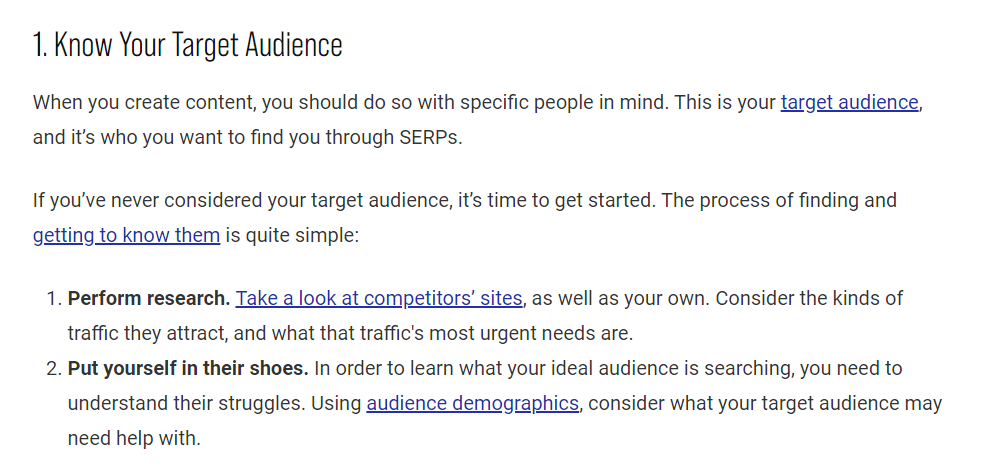
Además, estos enlaces pueden ayudar reducir la tasa de rebote by encouraging readers to check out other posts on your site. This user engagement can show search engines that you publish high-quality content, and that you’re an expert in your niche. Therefore, it may help you climb the rankings and attract more traffic to your site.
However, it’s important to remember that contextual links are not the only ranking factor. There are other elements that can help you climb the rankings, including palabras clave de cola larga e imágenes optimizadas.
Consejos para mejorar el uso de enlaces en su sitio web
As we have seen, contextual links can help you improve your rankings. Let’s look at some tips for using them effectively on your site.
First, you’ll want to make sure your anchor text includes words or phrases that are related to the article you’re linking to. This way, search engines will be able to understand the relevance of the links when crawling your site.
Secondly, you’ll want to avoid rellenar los mensajes con enlaces. Si tiene demasiados enlaces en su página, los motores de búsqueda podrían considerarlo spam y penalizar su sitio.
Additionally, it’s important to ensure that your links fit naturally within your post. The text shouldn’t be manipulated to create linking opportunities.
Por último, le recomendamos que dé prioridad a los enlaces a sitios web consolidados y fuentes autorizadas, especialmente cuando cite estudios o mencione estadísticas:
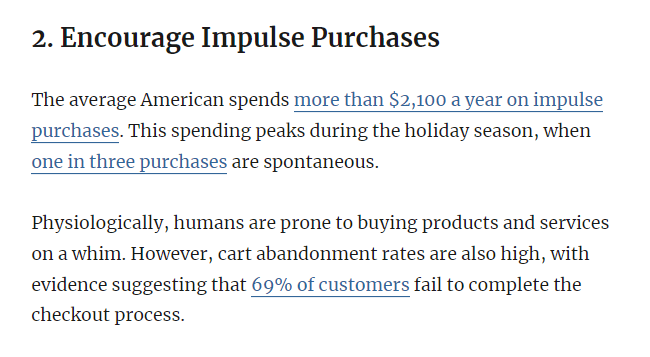
Recuerde que los algoritmos están diseñados para promover las páginas más relevantes y útiles para los usuarios. Por lo tanto, los enlaces contextuales a páginas de alta calidad pueden considerarse más valiosos y ayudarle a posicionarse mejor.
Conclusión
If you want to improve your site’s performance in Google, contextual links are an excellent place to start. By making a few small changes in the way you use links in your content, you can begin to climb those rankings more quickly.
In this post, we shared a few tips for improving link usage on your site. For instance, links should fit naturally into your content. You’ll also want to make sure that the anchor text is related to the linked post, so that readers know where they’re going. In addition, it’s important that you prioritize quality over quantity, and link to authoritative sources.
¿Tiene alguna pregunta sobre el uso de enlaces contextuales en su sitio web? Háganoslo saber en la sección de comentarios.
Si te ha gustado este post, no dejes de seguirnos en Twitter, Instagram, Facebook, Pinteresty LinkedIn! And don’t forget to subscribe in the box below.
This is really amazing information it would really help Improving Link Usage keep posting such amazing.
Artículo muy informativo. Tendré todas las cosas en cuenta la próxima vez que haga enlaces contextuales para mi sitio web.
muchas gracias.
La construcción de enlaces es uno de los mejores métodos y tienen un gran impacto en seo. Su artículo es grande y contiene conocimientos informativos sobre la construcción de enlaces. Gracias por ello, me ayuda mucho.
Muy buen artículo. Compartiré esta útil información con los demás.
Este método es útil para aumentar el tráfico.
Es muy Fantástico y bueno
Muchas gracias.
Bueno, no hay duda de que los enlaces no contextuales vale la pena practicar en 2022, pero creo que un enlace contextual es más impactante y bueno para su sitio.
No hay duda de que los enlaces contextuales son uno de los tipos más populares, pero no se pueden subestimar los enlaces no contextuales.
Yo uso este método perfecto para backlinks
En realidad lo estaba buscando. Realmente me ayudó. Gracias.
Esta información es excelente. Es bastante útil para backlinks. ¡Gracias por compartir tu blog!
Aunque los enlaces contextuales son bastante comunes, no hay que descartar la importancia de los enlaces no contextuales.
Es muy útil para mí. Amzing información para backlinks.
Gracias
Hola,
Soy nuevo en Canadá y comenzando mi carrera en SEO, es muy difícil conseguir palabras clave rango. Yo estaba buscando algunos blogs para adquirir conocimientos y aterrizó en su sitio web.
Gracias por compartir esta información.
He encontrado muy buena información sobre enlaces contextuales. Your article is great & contains informative knowledge regarding link building. I will keep all the things in mind next time making contextual links for my website. Voy a compartir esta información útil con los demás. Muchas gracias por compartir esto.
Hola
I'm new to UK and starting my career in tourism maintainig a website, it's really tricky to get keywords rank. I was looking for some blogs to gain knowledge and landed on your website.
Gracias por compartir esta información.
Qué ensayo tan valioso e instructivo.
Gracias a su clara redacción, ahora comprendo perfectamente este tema.
En cualquier sitio web o cosas en línea, el contenido fuerte juega un papel importante.
no olvide el seo on page y los enlaces internos.
gracias por este artículo
Su post es increíble. Sigue escribiendo próximos posts.
Gracias por compartir este artículo informativo sobre los enlaces contextuales y su impacto en el ranking de Google. Estoy completamente de acuerdo en que los enlaces contextuales son una parte crucial de cualquier estrategia SEO, ya que ayudan a establecer la relevancia y la autoridad dentro de un sitio web. En general, este es un gran recurso para cualquiera que busque mejorar el ranking de su sitio web a través de estrategias eficaces de construcción de enlaces. Gracias de nuevo por compartirlo.